Showing posts with label Woodward. Show all posts

1922 Photo Essay: The Bluestone Industry of Pike and Wayne Counties PA

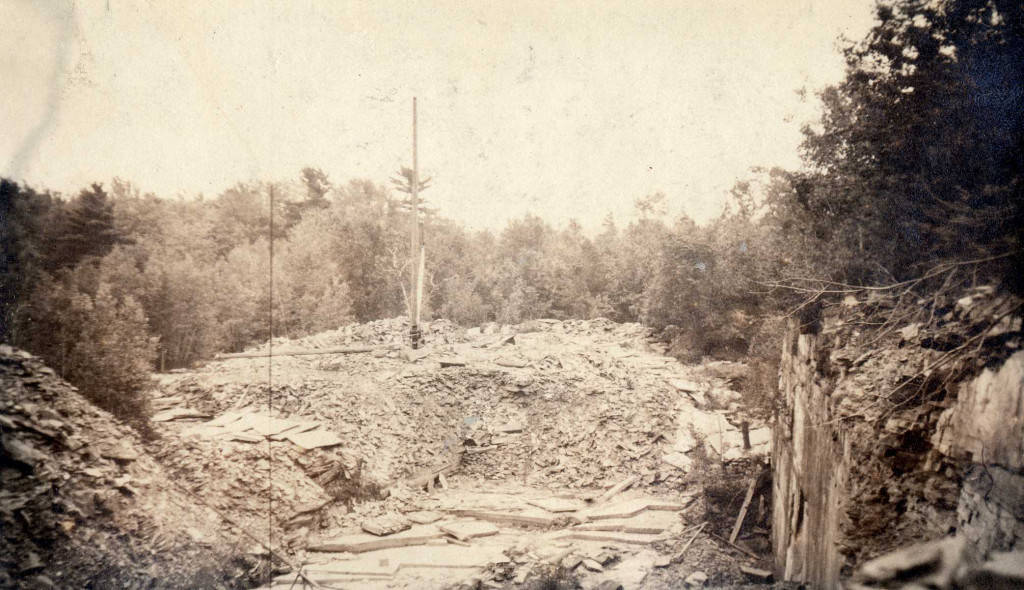
The dense, hard, and fine-grained sandstone of the Catskill Formation once known as "Delaware Flags" and sold as "Blue Stone" during the heyday of the 19th century bluestone industry in northeastern Pennsylvania, was extensively documented by Ralph W. Stone of the Pennsylvania Geological Survey in August of 1922. He traveled with an assistant and frequently camped out along the way. Stone’s subsequent article, The Flagstone Industry of Northeast Pennsylvania, Penn. Geo. Survey Bulletin 72, would appear in 1923.  A selection of his 1922 photos from the Pennsylvania Geological Survey Historical Photograph Collection follows.  Click the photos to enlarge.


Delaware River bluff, State highway near Dingmans Ferry

Hand painted lettering on the rear of the cab and doors identified the vehicle as officially "Penna Geological Survey". 


Flagstone quarry, J. V. Hood, Dingmans Ferry, Pike County

John Van Sant Hood, teacher and Justice of the Peace in Dingmans Ferry in 1917.


Delaware River bluff and Milford Knob

The Devonian era mapped bedrock unit, Mahantango Formation, Hamilton Group.

School house, built of Catskill sandstone, Milford

Note "stone from Dwarf Kill, five miles west of Milford," Pike County.  Building contractor Edwin Stanton Wolfe, 1903. 


Flagstone quarry (Point quarry), Lackawaxen, Pike County


Sandstone (Catskill) curbing, Lackawaxen, Pike County


Sandstone (Catskill) from Kilgour quarry, Lackawaxen Station


Sandstone quarry (Catskill), A. H. Woodward & Son, Kimbles, Pike County


Sandstone quarry (Catskill), Standard Blue Stone Company, Kimbles, Pike County
The consortium of the Standard Blue Stone Company, based in New Jersey, included Frank Kilgour, son of the "Bluestone King" John Fletcher Kilgour (1841-1904). John F. Kilgour established the bluestone industry in Pennsylvania, gaining and losing two fortunes over the course of his life.  In the early spring of 1922, the Standard Blue Stone Company, under court ordered Partition, auctioned off 7500 acres in twenty nine tracts located in Milford, Lackawaxen, Shohola, and Westfall Townships.  Frank Kilgour, with Arthur W. Clapp of the Erie Railroad, would assume control of the company.     

Sandstone (Catskill) in canal aqueduct (abandoned), Lackawaxen, Pike Co.
Note "Building Stone. Shows chisel marks..." The Roebling Aqueduct, Delaware & Hudson Canal, opened in 1849. 


Flagstone quarry, John H. Bowen, Aldenville, Wayne County


Flagstone at 514 Church Street, Honesdale, Wayne County

"Quarried at White Mills, six mile out. Measures 7' 11" x 22' 3". Home of Mrs. Anna O'Connell"


Sly Lake (near Lake Como), Preston Township, Wayne County


Geologic Map of Pike County, Pennsylvania, 1978, Topographic & Geologic Survey
For the article, “Bluestone in Pike County,” Pennsylvania Geology, June 1978, ninety-two inactive quarries were examined in Pike County.  As noted by the author, W. D. Sevon, the 19th century quarries were located on steep sided slopes by the river within convenient reach of railroad transportation. Bluestone slabs were used for flagstones, veneer,  tread, coping, sill, wallstone, slab stock, hearthstones and mantles. Peter Becker, Managing editor of the News Eagle, in his recent article,  A Legacy of Stone: Bluestone Quarries, profiles the last of the bluestone men, "Wayne Holbert, of Lackawaxen, still quarries and sells bluestone, a business that started with his great grandfather in the late 19th Century."


Works of the Kilgour Blue Stone Co., Ltd. Parkers Glen, Pike Co PA. 1886. 


Cornerstone of the Pike County Courthouse, Milford PA.

9000 Acres on the River Lachawaxen, 1785

New Jersey Gazette, February 21, 1785

Rich in period detail, this advertisement for land "situate on the river Lachawaxen" came to light while researching that variant in America's Historical Newspapers, available through the Pike County Public Library / Free Library of Philadelphia partnership. The ad, at varying length, would run from November 1784 to April of 1785 in the New Jersey Gazette, the Pennsylvania Packet and the Pennsylvania Journal. 

The prevailing currency of the time, the British pound, £., is used in a summary of timber industry costs, including occasional rum for the sawmill manager, for a period of five years. 

Transcription of the Advertisement
TO BE SOLD,
NINE thousand acres of land, situate on the river Lachawaxen, about ten miles from Delaware river, and about one hundred miles from Trenton-Landing, to which large boats and rafts do commonly run from Lachawaxen in two or three days.  On this tract there is a great quantity of white and yellow pines of every size, from an eighty feet mast to the size of a spar; the pines are straight and thrifty, and are equal to any on the Delaware for masts, spars or boards.  It is accommodated with four millseats, on which sawmills may be erected to great advantage -- and the whole tract may be properly divided in two equal parts, to each of which there would be three hundred acres of excellent meadow ground, a hundred acres of which are cleared, and produces wild grass in abundance.  From the mills, when built, rafts, from twenty to thirty thousand feet of boards in each, may be sent down these rivers to Philadelphia.
     Time will be given for payment of part of the purchase money, and the remainder will be taken in loan office certificates.  Apply to Michael Hillegas, Esquire, Reuben Haines or Richard Wells, in Philadelphia, or to the subscriber at Trenton.
     The inland navigation of the Delaware has been so little attended to for several years past, that at present it is imperfectly known to many, who, if they were acquainted with its advantages, would suddenly reap profits that in future cannot be obtained without a great increase of their capital:  I have therefore subjoined an estimate of the expences (sic) for which a sawmill, with four saws, may be carried on on the above estate.

CUTTING the logs,                    -            £. 0 2 6
Hauling do. for five years, to
keep four saws cutting 250 days
of each year,                               -             0 5 0
The Sawyer, the same as is generally
given in the counties of Burlington
and Gloucester,                            -            0 7 6
Manager's wages, and rum
occasionally                                 -             0 5 0
Rafting, and every contingent charge
included, to Philadelphia,
and delivering,                             -            1 0 0
                                                                ______ 40f (shilling) per m. (mile)

N.B. If the boards are delivered
at Trenton-Landing, the expence
of rafting will not exceed 12f 6p.m.
I suppose four saws will cut 800 m.
feet per annum, and that when
delivered at Philadelphia they
will sell for £. 6 per m.                          4800 0 0
Deduct 40f per m. raft cost,                   1600 0 0
                                                           _________
                                                         £.3200 0 0
I allow, in addition to this esti-
mate, for accidents and charges
arising from delays, per annum,              500 0 0
                                                            _________
Net profit gained per annum,              £.2700 0 0

IN the foregoing estimate no notice is taken of the profits arising from rafts of masts from sixty to seventy feet long, each stick proportioned; nor of the singular advantages gained by sawing deck-plank of forty-five feet long:  They will, I believe, readily sell for thirty-five shillings per hundred feet; if reduced to board measure, would be equal to seventeen shillings and six pence per hundred; it is therefore evident, that deck-plank will produce a greater profit than boards -- and may be rafted with as little trouble, and more safely, than masts or spars.

We find, at present, a ready market for boards and scantling at Trenton; and if they are of the first quality, they will generally sell for six pounds per thousand; and when the permanent seat of Congress is fixed on the banks of the Delaware, may I not say that the demand for those articles will increase, and that the prices will rise in proportion to the demand?"
                                                                                           Robert Lettis Hooper, jun.
Trenton, January 27, 1785.
~~~~~

By 1808, the economic benefit of the timber industry was important enough for Pennsylvania to declare part of the Lackawaxen River a public highway for those "desirous of using the navigation of said river...as may be necessary for the passage of rafts, boats and other vessels..." Laws of the Commonwealth of Pennsylvania, 1808.